
INTERMITTANT PERSECUTION OF QUAKERS CONTINUES UNDER THE BRITISH
TITLE: Address of Henry Willis and John Bowne to the Governor and his Council at New York
DATE: 4th of 7th month [September] 1680 [Old Style]
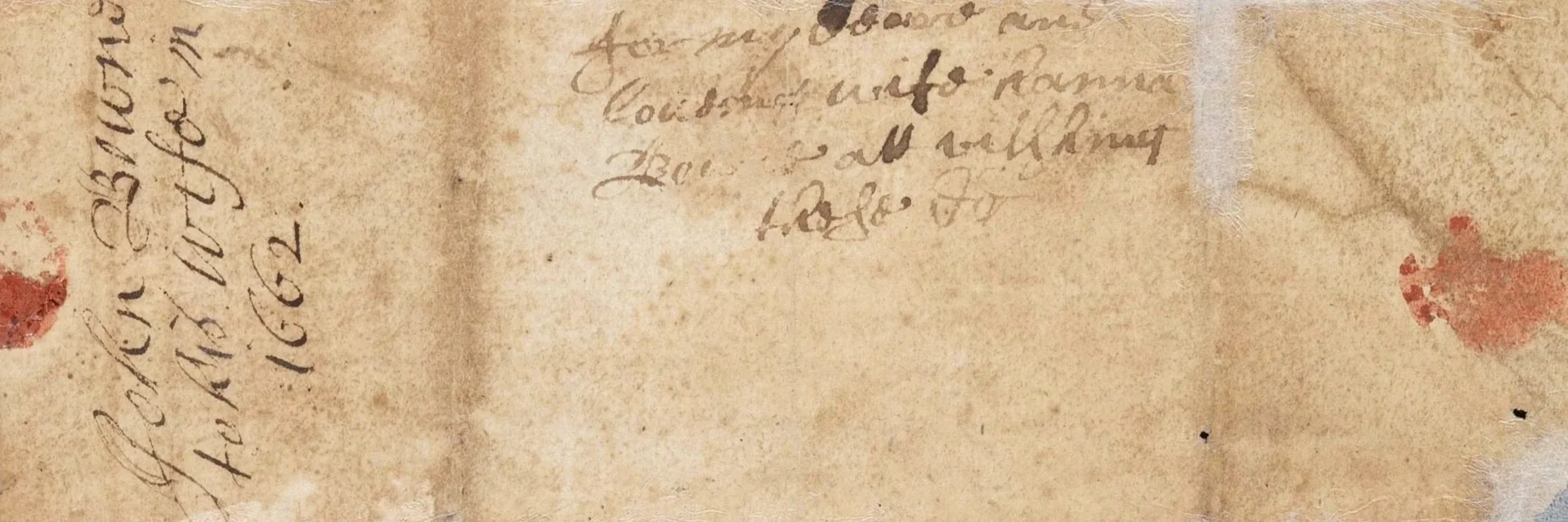
Photostatic copy of a document from the New York Colonial Records, found at Bowne House. Scroll down to see transcription and notes.
Shown: Mounted photostat from Bowne House Archives. Location of original most likely New York State Archives.
TRANSCRIPTION
(spelling has been modernized and punctuation added in places for clarity)
To the Governor; And his Council at New York:
The address of Henry Willis and John Bowne, concerning the proceedings of a Court of Sessions against us, who said they fined us 10£ apiece for suffering our daughters to marry contrary to their law,[1] which proceed-ing we are satisfied is without precedent, and we can count it no less but a mistake or hasty oversight, and though we have endeavored for its removal, yet execution is [leashed?] forth and Jos. Lee, Undersheriff, hath seized John Willis’ barn of corn and since taken from Jo. Bowne 5 good milk cows and drove them away by night and kept them penned from food most of two nights, one day and part of a day, [so] that neighbors was generally troubled at it. Now in simplicity we do seriously entreat all that may be concerned here-in, seriously to consider it and in the coolness of your spirits, without anger or harsh thoughts, truly to weigh it in the balance of equity where the witness of God may arise in every conscience to testify: whether if such things should go on and be proceeded in, it would not be to the [ruinating?] of families and to the kindling of God’s anger against a place or people, which we truly desire may be prevented by taking away the occasion, wherefore we make our addressto the chiefs in authority, knowing that Magistrates’ authority is to preserve men’s persons and estates, but the prerogative of the conscience, that be-longs to God and we dare not act (as sometimes represented) in stubbornness, obstinacy or contempt of authority, but in simplicity, having God’s fear in our hearts, that we may keep our consciences clear before Him from whom we receive strength to uphold us in trials and exercises and we earnestly desirethe Lord may persuade your hearts, unto whom we are now concerned, that ye may remove the cause of this our address, and open that eye in you that can see us as we are, who can pray for those that’s in authority, that under them we may live peaceable, holy and godlike life.
ye 4th of ye 7th mo. 1680[2] Henry Willis
John Bowne
NOTES:
[1] Quakers did not believe in civil marriage and so did not marry before an ordained minister or Justice of the Peace, nor register their unions with the government. Couples simply took their vows before God with the assembled members of the Quaker Meeting as witnesses, which Quakers argued was dictated by Old Testament precedent. Therefore, officials occasionally accused Quakers of “living in sin” and having illegitimate children, or (in this case) allowing their grown children to enter into such “illicit” unions.
[2] The Old Style of dating used by English subjects until 1752 followed the Julian calendar and began the New Year in March; thus the “7th month” was September.
