
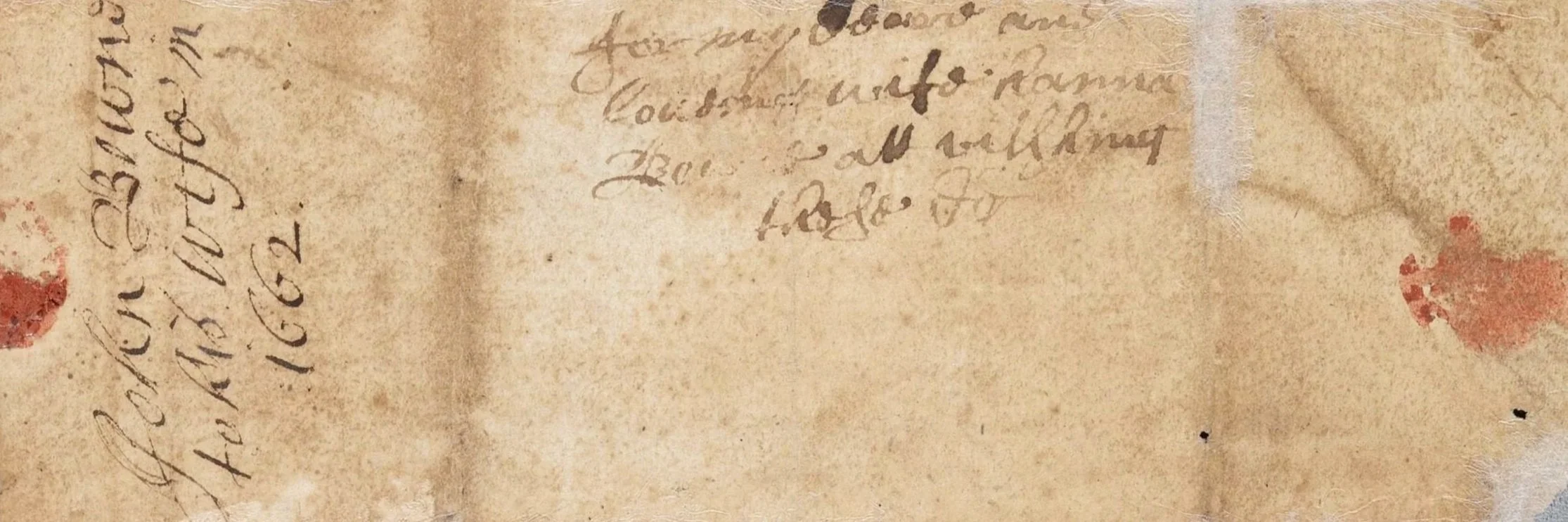
The infamous Salem Witch Trials have entered the popular imagination to an extent few other 17th-century American events can match. Over the course of 17 months in 1692 and ‘93, over 200 people living in the Massachusetts Bay Colony were accused of witchcraft, 30 were convicted, and 20 were executed, while others died in jail awaiting trial. The majority of the accused were women, fitting misogynistic assumptions of the time. However, around forty men were also accused of witchcraft. One of these was a thirty-year-old Andover resident named Edward Farrington, who happened to be a relation by marriage to the Bowne family of Flushing.
Here we see the two indictments filed against Farrington in mid-January 1693, for “Covenanting with the Devil” and “Afflicting Mary Warren.” Note that these papers and much more can be found at the Salem Witch Trials Documentary Archive and Transcription Project, hosted at the University of Virginia. The originals are in the Massachusetts Archives.
INDICTMENT OF EDWARD FARRINGTON FOR COVENANTING WITH THE DEVIL
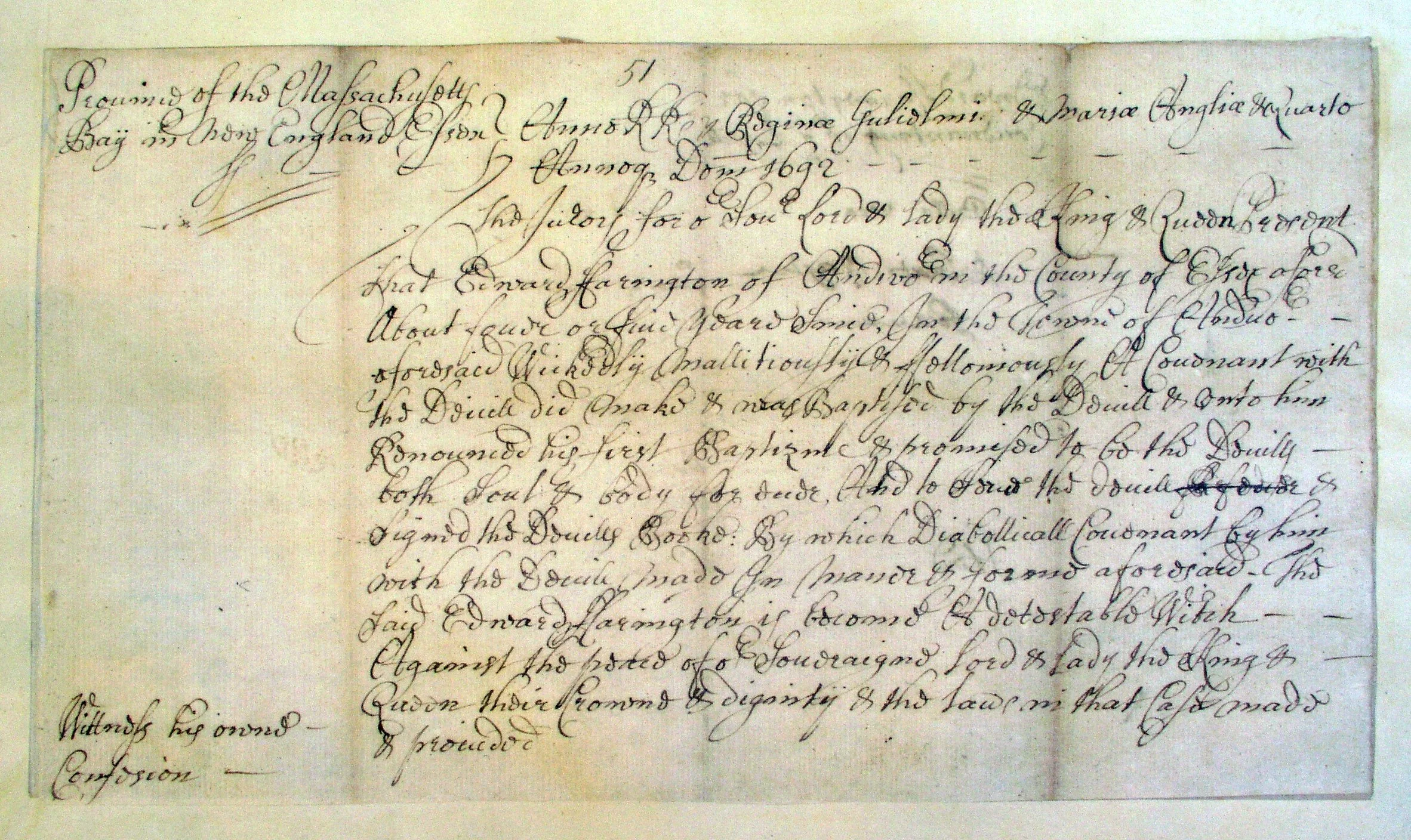
Salem Witchcraft Papers (SWP) No. 051.1
What the grand jury found:
“… Edward Farington of Andivor in the County of Essex afors'd Above fouer or five years Since, In the Towne of And[i]vor aforesaid Wickedly Mallitiously & felloniously A Covenant with the Devill did Make & was Baptised by the Devill & unto him Renounced his first Baptizme & promised to be the Devills both Soul & body for ever, And to Serve the devill & Signed the Devills Booke; By which Diabollicall Covenant by him with the Devill Made In Maner & forme aforesaid -- The Said Edward Farington is become a detestable Witch…”
INDICTMENT OF EDWARD FARRINGTON FOR AFFLICTING MARY WARREN
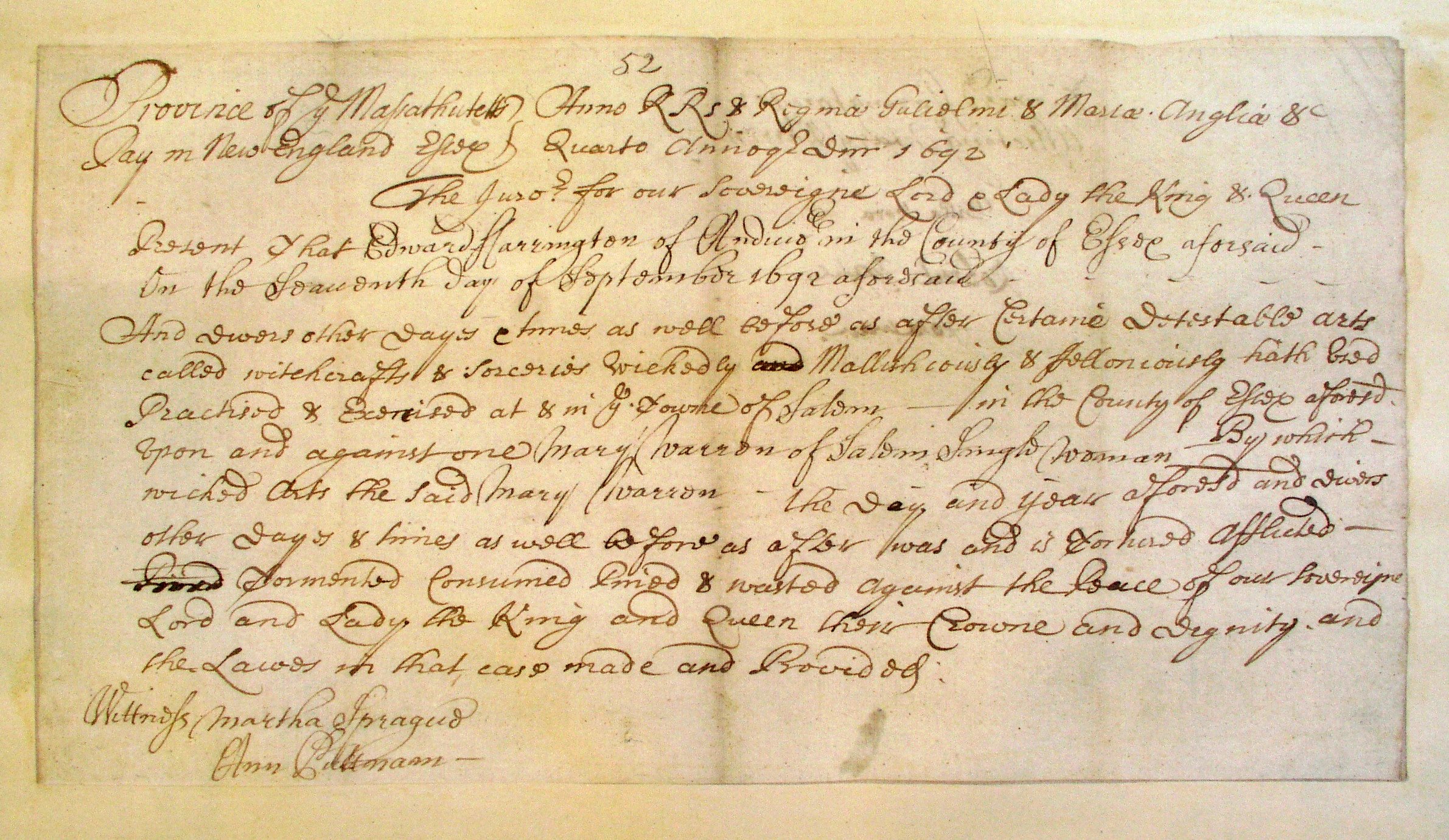
Salem Witchcraft Papers (SWP) No. 051.2
What the grand jury found:
“ Edward Farrington of Andivor in the County of Essex…Certaine Detestable arts called witchcrafts & Sorceries Wickedly and Mallishiously & felloniously hath Used Practised & Exercised at & in the Towne of Salem, in the County of Essex aforsed Upon and against one Mary Warren of Salem Single Woman By which wicked Arts the said Mary Warren the Day and year afores'd and Divers other Dayes & times as well before as after was and is Tortured Afflicted Pined & Tormented Consumed Pined & wasted…”
A note in the margin of the indictment for Covenanting says “Witness his owne Confession.” Two witnesses appear on the second indictment: Martha Sprague of Andover and Ann Puttnam of Salem. This means they had attested to seeing Farrington, or a spectre in his form, attack Mary Warren. Both were also alleged victims of witchcraft, and notably both were underage. Ann Puttnam was just 12, which technically meant her testimony should not have been relied upon in court. As an adult, she gave a heartfelt apology to those she had accused, blaming the Devil for deceiving her.
These papers and much more can be found at the Salem Witch Trials Documentary Archive and Transcription Project, hosted at the University of Virginia.
WHO WAS EDWARD FARRINGTON?
So who was this self-confessed “Detestable Witch” who had been baptized by the Devil and “signed the Devil’s Book”? He is not one of the better-known Salem witches, and little documentation concerning him survives beyond the two indictments. For instance, we do not have a statement from his accuser, any record of his arrest, a transcript of his interrogation, or the confession he made; furthermore, it seems that the indictment never progressed to a trial. Nor did he apply for compensation in later years, as many other accused did. He seems to have lead an otherwise unremarkable life. In the 1680s he worked as a cooper, or barrel-maker; his step-father had been a weaver. At the time of his arrest, he was thirty years old and recently married to Martha Browne, with a newborn son.
How was he connected to the Bownes? Edward was a nephew of Edward Farrington, one-time Flushing Magistrate and Remonstrance signer, and his wife Dorothy Bowne. Dorothy was John Bowne’s sister, who had emigrated from England with him and their father. It was most likely the elder Edward’s marriage to Dorothy around 1651 that prompted John Bowne and their father Thomas to leave Boston and settle in Flushing. The accused witch was born to Edward’s brother John Farrington in 1662. His father died when he was young, and he was raised by his mother and step-father in Andover, Massachusetts, the community neighboring Salem Village. We do not know if he would have had much contact with his Flushing relatives after that, but he was still their nephew and they must have been at least distantly aware of him.
WHY WAS EDWARD FARRINGTON ACCUSED?
The accusation of Edward Farrington is all the more bizarre because there is no evidence that he actually knew the young woman that he was allegedly “afflicting.” Mary Warren, a 20-year-old maidservant, was one of the most prolific Salem accusers, fingering over 20 “witches,” half of whom were ultimately executed. (Ironically, she was also accused of witchcraft by others.) Even stranger, she may have implicated Farrington sight unseen. On September 7, 1692, the date cited in his indictment, the town of Andover subjected its population to a mass “touch test.” This was one of the methods prescribed by expert witch hunters for determining guilt. Several allegedly bewitched girls were summoned and brought blindfolded before the assembled residents. The girls convulsed and cried out in pain, indicating the presence of witches. Each resident then approached and laid hands upon the victims. If the convulsions temporarily stopped, that meant that the person who had just touched them was a witch (the idea being that the evil spirits possessing the victim had recognized their master and returned to the witch’s own body.) As he had no documented ties to Mary Warren, and his name does not appear in any other court records, it seems likely that he was accused by a blindfolded stranger during this touch test. About 18 people were arrested that day. Edward was in the wrong place at the wrong time.
Ultimately, 50 Andover residents were indicted before the magistrate decided things had gone too far—one in twelve residents. Incredibly, many readily confessed to the accusations, as did Farrington. Why? A cynical explanation is that by September 1692, they had observed that “witches” who confessed were usually pardoned, particularly if they then informed on others. Those who maintained their innocence were much more likely to be condemned. A less cynical explanation is that they too were caught up in the hysteria. They shared the Puritan worldview, in which the supernatural world, including witches and demons, was both present and potent in everyday life. One accused witch who confessed later claimed that she became momentarily convinced that she had in fact fallen under the Devil’s power and might have done the things attributed to her.
WHAT HAPPENED TO ACCUSED WITCH EDWARD FARRINGTON?
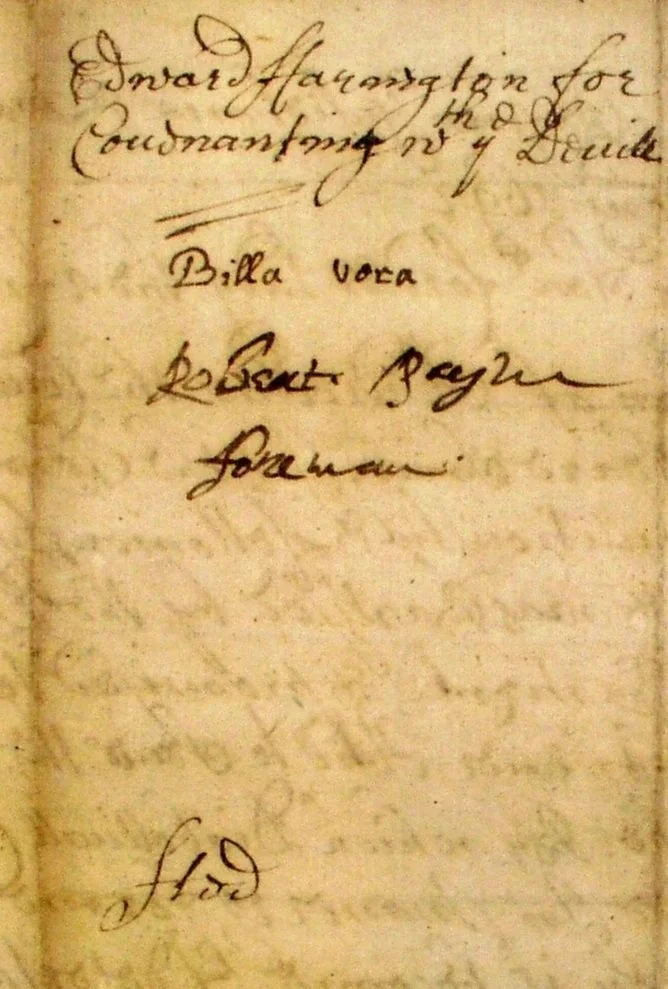
The word “Fled” on the back of the indictment.
There are no records of a trial for Edward. He was indicted just as the witch hunts were starting to wind down. If his trial was held over until the next session of the court (possibly due to the high volume of people accused in Andover) it may have simply been canceled. By the spring of 1693, the authorities were becoming alarmed by the scale of the hysteria and quietly concluded that the witch hunts needed to stop. (An accusation against the chief magistrate’s wife probably contributed to this conclusion.) Farrington may have been quietly released.
Another possibility is that he escaped shortly after his arrest and hid until it was safe to return. The back of the first indictment contains a scribbled word that looks like “Fled.” A Farrington family genealogy also claims that he broke out of jail in late September 1692. Certainly there were other accused people from Andover know to have gone on the lam. Either way, he seems to have lived out the remainder of his life quietly in Andover, among his accusers and fellow accused. He and his wife had five more children, and he died in 1747 at the ripe old age of 85.
WHAT DID THE BOWNES MAKE OF THE SALEM TRIALS?
The short answer is that we do not know. There is no mention of the Salem trials in John Bowne’s surviving papers. Both Edward Farrington (the elder) and Dorothy Bowne Farrington were dead by 1692, and its unclear how close the Flushing Farringtons were to their Puritan cousins in Massachusetts. Furthermore, the Quaker community was undergoing a major schism at the time, the George Keith affair, which was consuming their energies and much of the ink they spilt. (The Bowne Family Papers do mention George Keith.) It’s possible that the Salem Witch Trials were background noise to them, if they penetrated at all.
However, as Quakers the Bownes and Farringtons had faced their share of unfair persecution as a religious minority, and tended to be skeptical of authority and the mob mentality alike. Like other Christians at the time, they believed in witches and evil spirits, which figure in the Bible. There even appears to be a possible “witch-mark” engraved in the beam over the fireplace in the original c.1661 room at Bowne House, a folkway of keeping out evil spirits. However, Quakers tended to view spiritual warfare as an internal struggle, not something to be resolved on the gallows. If they were informed of Edward’s arrest, likely the Bownes would have extended sympathy to their accused in-law and wanted a fair hearing for him. Either way, the incident is a reminder of how close-knit and interconnected the early Colonial period truly was, and how real and omnipresent the supernatural world was to its inhabitants. Even the holiest, most blameless people were a mere couple degrees of separation from an accused witch.
